Evidence-Based Rehabilitation
Shockwave Therapy
Evidence-based guidance on extracorporeal shockwave therapy (ESWT) for tendon, joint, and spine-related musculoskeletal pain.
Medical Disclaimer
This page is intended for educational purposes only and does not constitute medical advice, diagnosis, or treatment. Always consult a qualified healthcare provider before starting any therapy. No pharmaceutical or medication recommendations are made on this site.
What Is Shockwave Therapy?
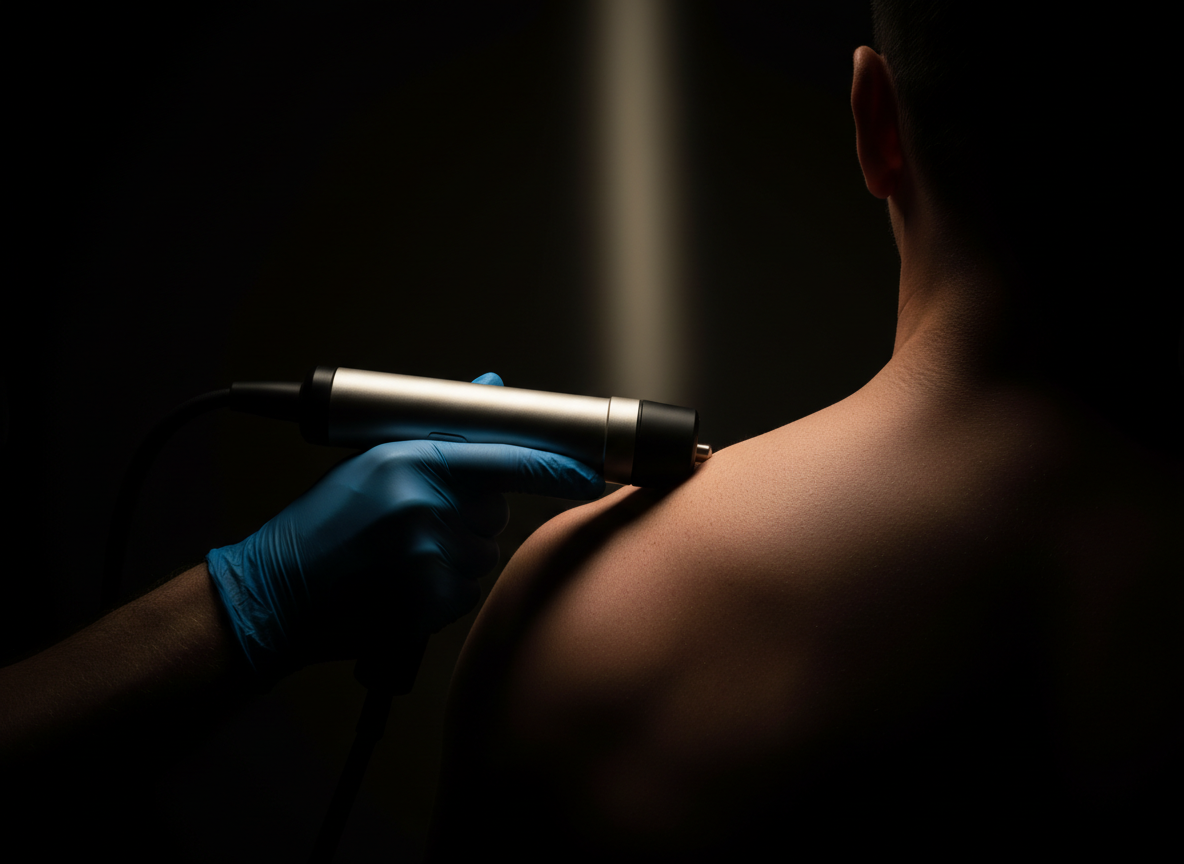
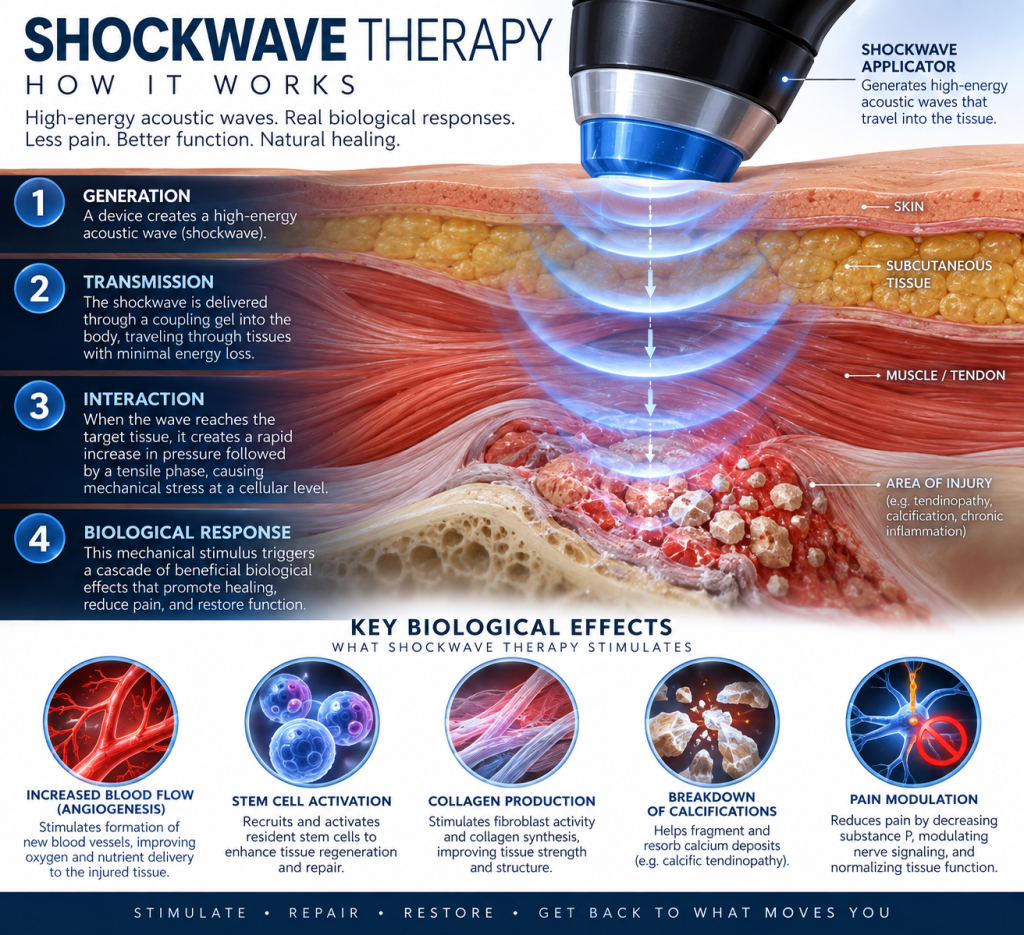
Extracorporeal shockwave therapy (ESWT) delivers high-energy acoustic waves to injured or degenerated tissue. There are two primary forms: focused ESWT (fESWT) and radial pressure wave therapy (RPWT).
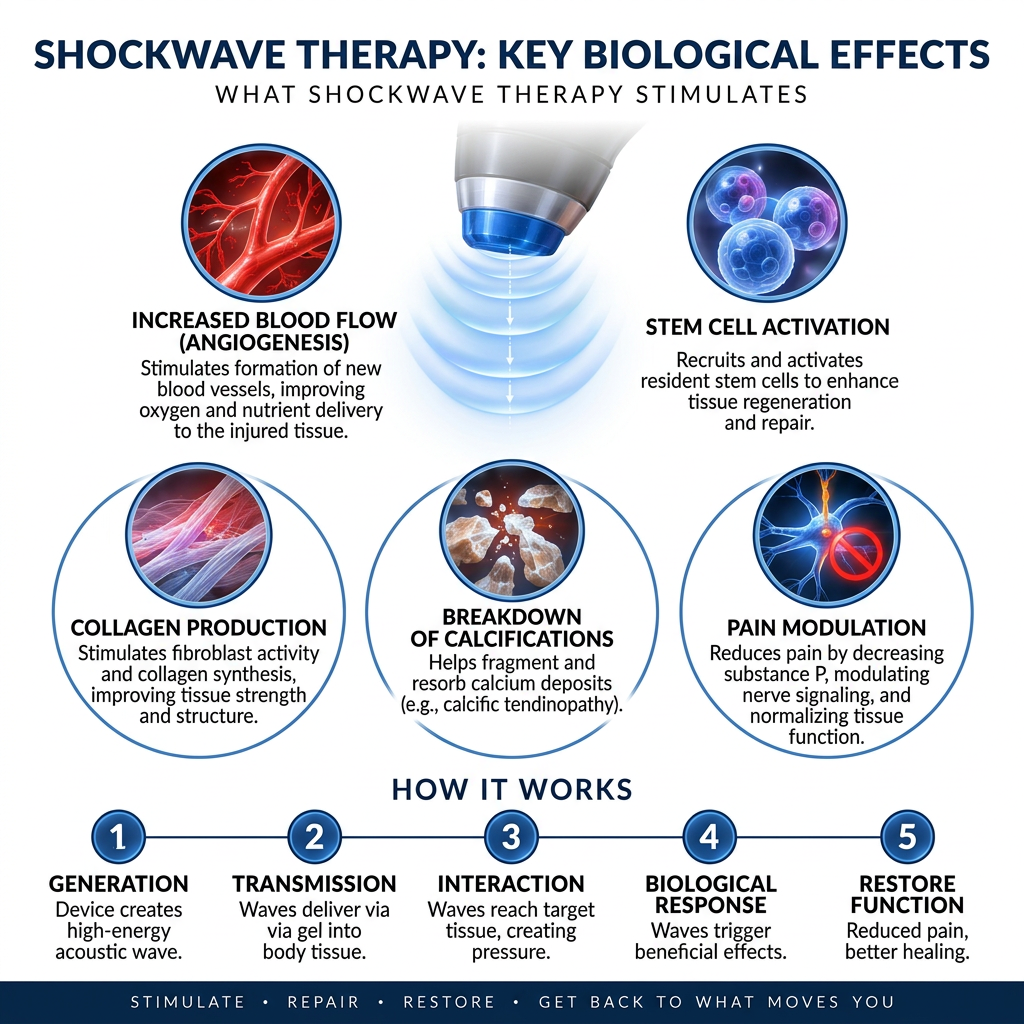
Its mechanisms include neovascularization, growth factor release (TGF-β1, VEGF, BMP), collagen remodeling, and central and peripheral pain desensitization via substance P reduction.
Notarnicola & Moretti 2012 (Muscles Ligaments Tendons J); Speed 2014 (Br J Sports Med).
Evidence by Condition
Tendon Conditions: What the Evidence Shows
Strong Evidence
Plantar Fasciitis / Heel Pain
Multiple RCTs and meta-analyses support ESWT as first-line or second-line treatment for chronic plantar fasciitis.
Aqil et al. 2013 (J Foot Ankle Surg); Zhiyun et al. 2013 (JBJS); Dizon et al. 2013 (J Rehabil Med).
Good Evidence
Achilles Tendinopathy
ESWT reduces pain and improves function in mid-portion and insertional Achilles tendinopathy, often comparable to eccentric exercise.
Rompe et al. 2007 (Am J Sports Med); Mani-Babu et al. 2015 (Am J Sports Med); Furia et al. 2006 (J Bone Joint Surg Am).
Moderate–Strong
Lateral Epicondylalgia (Tennis Elbow)
ESWT produces meaningful pain reduction and functional improvement, particularly when conservative care has failed.
Rompe et al. 1996 (JBJS Br); Buchbinder et al. 2005 (Cochrane); Spacca et al. 2005 (Eura Medicophys).
Strong (Calcific)
Rotator Cuff / Calcific Tendinitis
Highly effective at resolving calcific deposits and reducing associated pain; good evidence for non-calcific tendinopathy as well.
Gerdesmeyer et al. 2003 (JAMA); Ioppolo et al. 2012 (Am J Phys Med Rehabil); Engebretsen et al. 2009 (BMJ).
Good Evidence
Patellar Tendinopathy (Jumper’s Knee)
ESWT reduces pain and improves return to sport in athletes with chronic patellar tendinopathy.
Peers 2003 (Acta Orthop Belg); Wang et al. 2007 (Am J Sports Med); Dragoo et al. 2014 (Am J Sports Med).
Evidence by Condition
Joint Conditions: Emerging and Established Evidence
Strong Evidence
Hip GTPS
Greater trochanteric pain syndrome: ESWT outperforms corticosteroid injection at medium- and long-term follow-up.
Rompe et al. 2009 (Am J Sports Med); Furia et al. 2009 (J Bone Joint Surg Am).
Promising
Knee Osteoarthritis
ESWT reduces pain and improves function in knee OA, likely through chondroprotective and anti-inflammatory mechanisms.
Li et al. 2023 (Front Med); Zhao et al. 2013 (J Surg Res); Wang et al. 2012 (Arthritis Res Ther).
Emerging
Hip Osteoarthritis
Limited but positive RCT data support pain reduction; more studies are needed.
Leal et al. 2015 (Clin Rheumatol).
Clinical Protocol
How Shockwave Therapy Is Delivered
Treatment parameters vary by condition, device type, and patient response. The following reflects evidence-informed protocols used in clinical practice.
RSWT
Radial Shockwave
Radial devices disperse energy across a broad tissue area and are best suited for superficial tendons (Achilles, plantar fascia, lateral epicondyle). Typical protocol: 2,000–3,000 impulses per session, 3–5 sessions spaced 1 week apart, at 1.5–3.5 bar.
Mani-Babu et al. 2015 (Am J Sports Med).
FSWT
Focused Shockwave
Focused devices concentrate energy at a precise depth and are preferred for calcific deposits, hip GTPS, and deeper spinal trigger points. Delivers higher peak pressure with smaller focal area. Fewer sessions often required (3–4).
Speed 2014 (Br Med Bull); Gerdesmeyer et al. 2003 (JAMA).
Combination
Combined Protocols
Emerging evidence supports combining radial and focused modalities for complex presentations. Also frequently paired with eccentric loading programs for tendinopathy to augment collagen remodeling and functional outcomes.
Rompe et al. 2007 (Am J Sports Med); Lohrer et al. 2016 (Br J Sports Med).
Patient Selection
Who Is a Candidate for Shockwave?
ESWT is most appropriate for patients with chronic musculoskeletal pain (typically ≥3 months duration) who have not responded to conservative care including rest, physical therapy, and activity modification.
Good Candidates
- Chronic tendinopathy (Achilles, patellar, rotator cuff, lateral epicondyle)
- Plantar fasciitis refractory to stretching and orthotics
- Calcific shoulder tendinitis confirmed on imaging
- Greater trochanteric pain syndrome
- Myofascial trigger points — cervical or lumbar
- Chronic non-specific low back pain without nerve compression
Relative Contraindications
- Active infection or open wound at treatment site
- Coagulation disorders or anticoagulant therapy
- Malignancy at or near treatment site
- Pregnancy (over treatment area)
- Skeletally immature patients (open growth plates)
- Implanted cardiac devices (near thoracic spine)
Contraindication criteria per Schmitz et al. 2013 (Arch Phys Med Rehabil); Speed 2014.
Safety Profile
What to Expect: Side Effects and Safety
ESWT has a well-established safety profile when administered by trained clinicians. Adverse effects are typically mild and self-limiting.
Common (Transient)
- Localized soreness at treatment site (24–72 hrs)
- Mild swelling or erythema
- Transient increase in pain after first 1–2 sessions
- Petechiae or superficial bruising
Rare or Serious
- Hematoma formation
- Nerve irritation or paresthesia (rare)
- Tendon rupture (extremely rare; avoid injecting corticosteroids within 6 weeks)
- Skin burns (mitigated by proper gel coupling)
Adverse event data: Schmitz et al. 2013; Lohrer et al. 2016 (Br J Sports Med).
References
This page is intended for educational purposes only and does not constitute medical advice. Shockwave therapy should be pursued only under the guidance of a licensed healthcare provider. No pharmaceutical or medication recommendations are made on this site.
- Mani-Babu S, et al. The effectiveness of extracorporeal shock wave therapy in lower limb tendinopathy. Am J Sports Med. 2015;43(3):752–761.
- Speed C. A systematic review of shockwave therapies in soft tissue conditions. Br Med Bull. 2014;110(1):167–175.
- Gerdesmeyer L, et al. Radial extracorporeal shock wave therapy is safe and effective in the treatment of chronic recalcitrant plantar fasciitis. Am J Sports Med. 2008;36(11):2100–2109.
- Aqil A, et al. Extracorporeal shock wave therapy is effective in treating chronic plantar fasciitis. J Foot Ankle Surg. 2013;52(5):519–522.
- Zheng Z, et al. Extracorporeal shockwave therapy for plantar fasciitis. Medicine. 2016;95(45):e5189.
- Rompe JD, et al. Eccentric loading versus eccentric loading plus shock-wave treatment for midportion Achilles tendinopathy. Am J Sports Med. 2009;37(3):463–470.
- Rompe JD, et al. Eccentric loading, shock-wave treatment, or a wait-and-see policy for tendinopathy of the main body of tendo Achillis. Am J Sports Med. 2007;35(3):374–383.
- Rompe JD, et al. Low-energy extracorporeal shock wave treatment for chronic epicondylitis at the elbow. J Bone Joint Surg Br. 1996;78(2):233–237.
- Buchbinder R, et al. Shock wave therapy for lateral elbow pain. Cochrane Database Syst Rev. 2005;(4):CD003524.
- Gerdesmeyer L, et al. Extracorporeal shock wave therapy for the treatment of chronic calcifying tendinitis of the rotator cuff. JAMA. 2003;290(19):2573–2580.
- Ioppolo F, et al. Treatment of supraspinatus calcifying tendinitis with extracorporeal shock wave therapy. Am J Phys Med Rehabil. 2012;91(6):524–529.
- Peers KHE. Extracorporeal shock wave therapy in chronic patellar tendinopathy. Acta Orthop Belg. 2003;69(3):195–200.
- Wang CJ, et al. Shock wave therapy for calcific tendinitis of the shoulder. J Bone Joint Surg Am. 2003;85(2):232–239.
- Rompe JD, et al. Extracorporeal shock wave therapy for greater trochanteric pain syndrome. Am J Sports Med. 2009;37(10):1981–1990.
- Furia JP, et al. Extracorporeal shockwave therapy in the treatment of chronic greater trochanteric pain syndrome. J Am Acad Orthop Surg. 2009;17(7):432–437.
- Li S, et al. Extracorporeal shockwave therapy for knee osteoarthritis. Front Med. 2023;10:1101758.
- Zhao Z, et al. Effects of extracorporeal shockwave therapy on pain and function in patients with knee osteoarthritis. J Rehabil Med. 2020;52(2):jrm00017.
- Leal C, et al. ESWT for the treatment of hip osteoarthritis. Clin Rheumatol. 2015;34(6):1011–1016.
- Gleitz M, Hornig K. Trigger points — diagnosis and treatment concepts with special reference to extracorporeal shockwaves. Der Schmerz. 2012;26(3):255–266.
- Jeon JH, et al. Application of extracorporeal shock wave therapy for myofascial pain in the neck and shoulder. J Korean Med Sci. 2012;27(6):665–669.
- Seco J, et al. The efficacy, safety, effectiveness, and cost-effectiveness of ultrasound and shock wave therapies for low back pain. Spine J. 2011;11(10):966–977.
- Visco V, et al. Extracorporeal shockwave therapy for chronic low back pain. J Back Musculoskelet Rehabil. 2022;35(1):107–114.
- Han DS, et al. Efficacy of extracorporeal shockwave therapy for sacroiliac joint dysfunction. Pain Med. 2017;18(1):49–57.
- Lohrer H, et al. Extracorporeal shock wave therapy for patients suffering from recalcitrant lateral epicondylitis. Br J Sports Med. 2016;50(23):1428–1434.
- Schmitz C, et al. Efficacy and safety of extracorporeal shock wave therapy for orthopedic conditions. J Orthop Surg Res. 2013;8:1.
- Notarnicola A, Moretti B. The biological effects of extracorporeal shockwave therapy (ESWT) on tendon tissue. Muscles Ligaments Tendons J. 2012;2(1):33–37.
- Wang CJ. Extracorporeal shockwave therapy in musculoskeletal disorders. J Orthop Surg Res. 2012;7:11.
- Rompe JD, et al. Shock wave application for chronic plantar fasciitis in running athletes. Am J Sports Med. 2003;31(2):268–275.
- Ogden JA, et al. Shockwave therapy for chronic proximal plantar fasciitis. Clin Orthop Relat Res. 2001;387:47–59.
- Lippi G, Longo UG, Maffulli N. Genetics and sports. Br Med Bull. 2010;93:27–47. [Cited for biological variability in tendon healing response.]
 Dr. Austin Fontenot