
Recovery · Evidence-Based Guidance
Recovery Takes Time. Here’s What’s Actually Happening.
Tissue repair is biology, not willpower. Understanding the phases — and what can derail them — changes everything.
The Biology of Repair
The Three Phases of Tissue Repair
Healing moves through overlapping stages. Each has its own biology, its own timeline, and its own risks if rushed.
Phase 1 · Days 0–7
Inflammation
A vascular response begins. Neutrophils and macrophages clear debris, and pro-inflammatory cytokines signal repair. This is NOT the enemy — suppressing it completely (NSAIDs overuse) can impair healing.
Wilgus TA et al., Advances in Wound Care, 2013.
Phase 2 · Weeks 1–6
Proliferation
Fibroblasts lay down collagen — initially type III, immature. New blood vessels form. The tissue is fragile here; premature loading causes re-injury.
Järvinen TAH et al., Am J Sports Med, 2005.
Phase 3 · Weeks 6–Months 12–24
Remodeling
Type III collagen converts to type I — stronger. Tissue regains tensile strength but never reaches 100% of original. Tendon remodeling can take 1–2 years.
Woo SL et al., J Orthopaedic Research, 1999.
By Tissue Type
Tissue-Specific Timelines
Not all tissue heals at the same rate. Vascularity, structure, and load tolerance all shape realistic windows.
Muscle strain (Grade I–II)
2–8 weeks
Highly vascular; heals faster with graded loading.
Tendon (partial tear)
3–6 months
Poor vascularity; collagen maturation is slow.
Ligament (Grade II)
6–12 weeks
Scar tissue forms; proprioception rehab essential.
Bone stress fracture
6–12 weeks
Requires offloading; nutrition critical (calcium, D3).
Disc (acute herniation)
6–18 months
90% of disc herniations resolve without surgery (Zhong M et al., Pain Physician, 2017).
Nerve (peripheral)
Months–years
Grows ~1mm/day; functional return depends on continuity.
Dommerholt J & Fernandez-de-las-Penas C, Trigger Point Dry Needling, 2013; Khan KM & Scott A, Br J Sports Med, 2009.
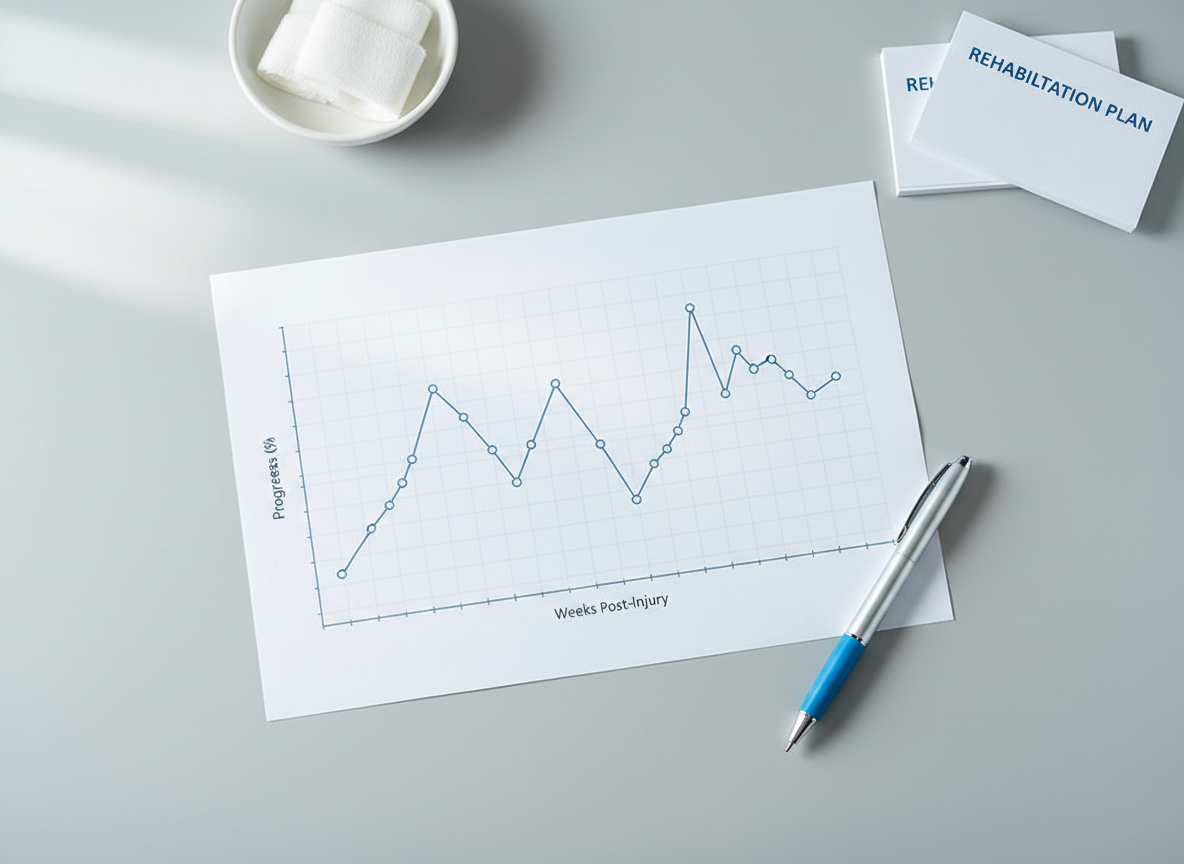
Expectations vs. Reality
What Progress Actually Looks Like
Patients often expect a straight line down. Real recovery is a jagged, upward trend — with setbacks that don’t mean failure.
- Recovery is not linear. Good days followed by bad days is normal, not failure.
- Pain is not a reliable proxy for tissue damage (Moseley GL & Butler DS, The Explain Pain Supercharged, 2017).
- Functional milestones matter more than pain scores (Terwee CB et al., J Clin Epidemiology, 2007).
- Sleep, stress, and nutrition modulate healing speed independently of the injury itself (Oyewole OO et al., Journal of Pain Research, 2018).
Recovery Modulators
What Speeds (and Slows) Healing
The variables that matter most — and the ones you can control.
Sleep
Sleep Quality
Growth hormone peaks during slow-wave sleep. Poor sleep increases inflammatory cytokines and slows collagen synthesis — making adequate rest a non-negotiable component of tissue repair.
Besedovsky L et al., Pflugers Arch, 2012.
Stress
Psychological Stress
Elevated cortisol suppresses fibroblast activity and delays wound closure. Psychological stress is a documented predictor of poor recovery outcomes — independent of injury severity.
Gouin JP & Kiecolt-Glaser JK, Immunol Allergy Clin North Am, 2011.
Nutrition
Nutritional Support
Protein (1.6–2.2g/kg/day), vitamin C, zinc, and collagen peptides taken with vitamin C pre-exercise directly support tissue repair and collagen synthesis.
Shaw G et al., Am J Clin Nutr, 2017.
Functional Milestones
Stop Measuring Pain. Start Measuring Progress.
Pain is a poor proxy for tissue health during recovery. These functional markers are more reliable indicators that healing is on track.
Early Milestones (Weeks 1–6)
- Full passive range of motion restored
- Reduced swelling and localized heat
- Tolerance to gentle, progressive loading
- Improved sleep quality
- Reduced reliance on pain medication
Later Milestones (Weeks 6–24+)
- Return to bodyweight exercise without pain
- Tolerance to progressive resistance loading
- Sport- or task-specific movement patterns without compensation
- Sustained activity without next-day flare-up
Kibler WB et al., Am J Sports Med, 2006.
Nutrition for Tissue Repair
Feed the Repair
What you eat directly influences how fast and how well your tissue heals. These three nutritional pillars have the strongest evidence base.
Protein
Protein Intake
1.6–2.2g/kg/day supports muscle and connective tissue synthesis. Leucine-rich sources — eggs, whey, and meat — are the most anabolic and most effective for repair.
Morton RW et al., Br J Sports Med, 2018.
Collagen + Vitamin C
Collagen + Vitamin C
15g collagen peptides combined with 50mg vitamin C, taken 30–60 minutes before rehabilitation exercise, measurably increases collagen synthesis in tendons and ligaments.
Shaw G et al., Am J Clin Nutr, 2017.
Anti-Inflammatory Foods
Anti-Inflammatory Foods
Omega-3 fatty acids (EPA/DHA), curcumin, and dietary polyphenols reduce systemic inflammation and may accelerate early-phase recovery.
Calder PC, Br J Clin Pharmacol, 2013.
Red Flags
When to Stop and Seek Help
Most recovery pain is expected and manageable. These signs indicate something that warrants immediate clinical evaluation.
- Severe or worsening pain that does not respond to relative rest or position changes.
- Neurological symptoms — numbness, tingling, or new muscle weakness.
- Loss of bowel or bladder control — seek emergency evaluation immediately.
- Fever or systemic symptoms such as unexplained weight loss or night sweats.
- Significant swelling, bruising, or deformity suggesting structural injury.
- Pain that wakes you from sleep consistently and does not settle.
Recovery Is a Process. You Don’t Have to Navigate It Alone.
Evidence-based guidance. Practical tools. A framework built on how tissue actually heals.
Flare-Ups
What They Mean and What To Do
“A flare-up is information, not a setback.”
A flare-up is NOT re-injury in most cases. It is a sensitization response — the nervous system is upregulated, not new damage occurring.
- Common triggers: overexertion, poor sleep, stress, weather changes, inactivity.
- What to do during a flare: reduce load — but do not eliminate movement. Apply ice in the acute/inflammatory phase; heat during the proliferative and remodeling phases. Stay active at a lower intensity to maintain circulation and tissue stimulus.
- What NOT to do: rest completely, panic, or assume re-injury has occurred. A flare-up is most often a sensitization response, not new structural damage.
Moseley GL & Butler DS, Explain Pain, 2nd ed., NOI Group, 2015.
References & Sources
1. Wilgus TA, Roy S, McDaniel JC. Neutrophils and Wound Repair: Positive Actions and Negative Reactions. Advances in Wound Care. 2013;2(7):379–388. DOI: 10.1089/wound.2012.0383.
2. Järvinen TAH, Järvinen TLN, Kääriäinen M, et al. Muscle Injuries: Biology and Treatment. Am J Sports Med. 2005;33(5):745–764. DOI: 10.1177/0363546505274714.
3. Woo SL, Gomez MA, Inoue M, Akeson WH. New experimental procedures to evaluate the biomechanical properties of healing canine medial collateral ligaments. J Orthop Res. 1987;5(3):425–432. DOI: 10.1002/jor.1100050315.
4. Zhong M, et al. Incidence of Spontaneous Resorption of Lumbar Disc Herniation: A Meta-Analysis. Pain Physician. 2017;20(1):E45–E52.
5. Spinner RJ, Kline DG. Peripheral nerve regeneration rate (~1mm/day). In: StatPearls. NCBI Bookshelf. 2023. NBK549848.
6. Besedovsky L, Lange T, Born J. Sleep and immune function. Pflugers Arch. 2012;463(1):121–137. DOI: 10.1007/s00424-011-1044-0.
7. Gouin JP, Kiecolt-Glaser JK. The impact of psychological stress on wound healing: methods and mechanisms. Immunol Allergy Clin North Am. 2011;31(1):81–93. DOI: 10.1016/j.iac.2010.09.010.
8. Shaw G, Lee-Barthel A, Ross MLR, Wang B, Baar K. Vitamin C–enriched gelatin supplementation before intermittent activity augments collagen synthesis. Am J Clin Nutr. 2017;105(1):136–143. DOI: 10.3945/ajcn.116.138594.
9. Morton RW, Murphy KT, McKellar SR, et al. A systematic review, meta-analysis and meta-regression of the effect of protein supplementation on resistance training-induced gains in muscle mass and strength. Br J Sports Med. 2018;52(6):376–384. DOI: 10.1136/bjsports-2017-097608.
10. Calder PC. Omega-3 polyunsaturated fatty acids and inflammatory processes: nutrition or pharmacology? Br J Clin Pharmacol. 2013;75(3):645–662. DOI: 10.1111/j.1365-2125.2012.04374.x.
11. Kibler WB, Press J, Sciascia A. The role of core stability in athletic function. Am J Sports Med. 2006;36(3):189–198. DOI: 10.1177/0363546505281785.
12. Moseley GL, Butler DS. Explain Pain. 2nd ed. Noigroup Publications; 2013.
13. Dommerholt J, Fernández-de-las-Peñas C. Trigger Point Dry Needling. Elsevier; 2013.
 Dr. Austin Fontenot