Protein Essentials
How much protein you need, best sources, and timing to rebuild muscle and recover.
Protein for Rehab and Aging
Most adults recovering from injury benefit from about 1.6–2.2 grams of protein per kilogram of body weight daily, split into 3–4 meals providing 25–40 grams each, emphasizing high‑quality sources to protect muscle and support healing in aging.
What Is Protein?
Protein is one of three macronutrients — alongside carbohydrates and fat — and it is the primary structural and functional material of the human body. Every cell contains protein. Proteins are composed of amino acids, small organic molecules linked together in chains. Of the 20 amino acids used in human physiology, nine are classified as essential (EAAs): the body cannot synthesize them and must obtain them through diet. The remaining eleven are nonessential or conditionally essential, meaning the body can synthesize them under normal conditions but may require dietary intake during periods of high physiological demand — such as injury, illness, or intense training.
Protein serves roles far beyond muscle: it forms enzymes, hormones (including insulin and growth hormone), antibodies, hemoglobin, and structural tissues such as collagen, tendons, ligaments, and cartilage. For anyone recovering from musculoskeletal injury or managing age-related muscle loss, protein is not optional — it is a clinical priority.
Sources: Wu G. Dietary protein intake and human health. Food Funct. 2016;7(3):1251–1265. | Wolfe RR. Branched-chain amino acids and muscle protein synthesis in humans. J Int Soc Sports Nutr. 2017;14:30.
Essential vs. Non-Essential Amino Acids
The nine essential amino acids are histidine, isoleucine, leucine, lysine, methionine, phenylalanine, threonine, tryptophan, and valine. Among these, the three branched-chain amino acids (BCAAs) — leucine, isoleucine, and valine — are of particular interest in rehabilitation and sports nutrition. Leucine acts as the primary anabolic signal that activates mTORC1, the master regulator of muscle protein synthesis (MPS). A meal containing approximately 2–3 g of leucine is generally sufficient to maximally stimulate MPS in healthy adults.
Conditionally essential amino acids — including glutamine, arginine, and glycine — become important during recovery from surgery, trauma, or critical illness. Glutamine supports gut barrier integrity and immune function; arginine is a precursor to nitric oxide and plays a role in wound healing; glycine is a key substrate for collagen biosynthesis, relevant to tendon and ligament repair.
Sources: Norton LE, Layman DK. Leucine regulates translation initiation of protein synthesis in skeletal muscle after exercise. J Nutr. 2006;136(2):533S–537S. | Newsholme P, et al. Glutamine and glutamate — their central role in cell metabolism and function. Cell Biochem Funct. 2003;21(1):1–9.
How Much Protein Do You Need?
General Population
The Recommended Dietary Allowance (RDA) for protein is 0.8 g per kilogram of body weight per day — a figure designed to prevent deficiency in sedentary adults, not to optimize muscle health, recovery, or aging. For most active individuals, this number is a floor, not a target.
Active Adults and Athletes
Current evidence from sports nutrition and exercise science consistently supports higher intakes. The International Society of Sports Nutrition (ISSN) recommends 1.4–2.0 g/kg/day for exercising individuals, with higher intakes (up to 2.2–3.1 g/kg lean body mass/day) being safe and potentially beneficial during periods of caloric restriction or intense training.
Injury and Surgical Recovery
Protein requirements increase substantially during recovery from musculoskeletal injury, orthopedic surgery, or immobilization. Studies suggest 1.6–2.5 g/kg/day to offset the accelerated muscle protein breakdown (MPB) associated with disuse atrophy, inflammation, and elevated catabolic signaling. Failing to meet these targets during recovery delays tissue healing, prolongs rehabilitation timelines, and accelerates muscle loss.
Older Adults (50+)
Sarcopenia — age-related muscle loss — begins as early as the fourth decade and accelerates after 60. Older adults exhibit anabolic resistance, meaning they require larger per-meal doses of protein to achieve the same MPS response as younger adults. Expert consensus from the PROT-AGE Study Group recommends 1.2–1.6 g/kg/day for healthy older adults, rising to 1.5–2.0 g/kg/day in those with acute or chronic illness.
Sources: Morton RW, et al. A systematic review, meta-analysis and meta-regression of the effect of protein supplementation on resistance training-induced gains. Br J Sports Med. 2018;52(6):376–384. | Jäger R, et al. International Society of Sports Nutrition Position Stand: Protein and exercise. J Int Soc Sports Nutr. 2017;14:20. | Deutz NE, et al. Protein intake and exercise for optimal muscle function with aging. Clin Nutr. 2014;33(6):929–936.
Best Protein Sources
Animal-Based Proteins
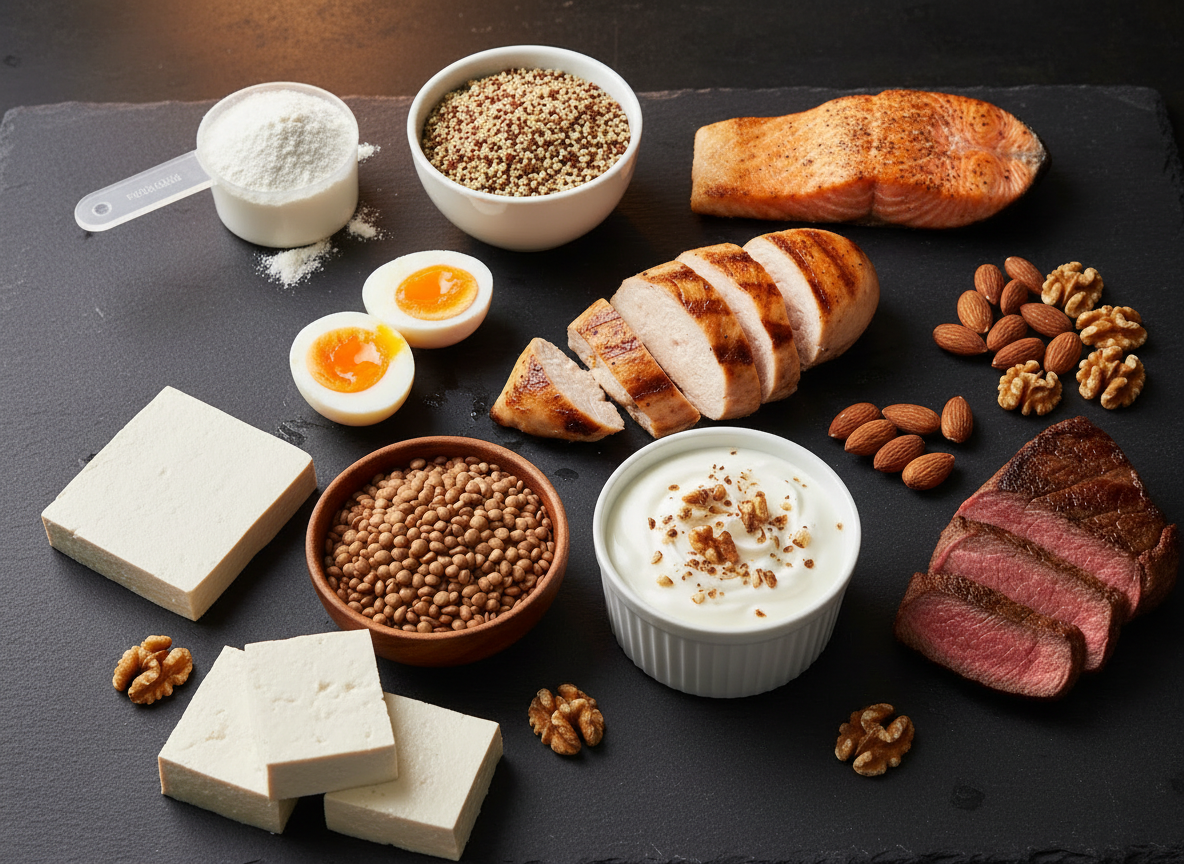
Animal proteins are complete proteins — they contain all nine essential amino acids in proportions that closely match human muscle tissue. Key sources include:
- Chicken breast — 31 g protein per 100 g
- Lean beef — 26 g per 100 g, rich in creatine and zinc
- Eggs — 6 g per egg, high bioavailability, rich in leucine
- Wild-caught salmon — 25 g per 100 g, plus anti-inflammatory omega-3s
- Greek yogurt — 10–17 g per 100 g, contains casein and whey fractions
- Cottage cheese — 11 g per 100 g, slow-digesting casein ideal for overnight recovery
- Whey protein concentrate/isolate — 20–25 g per serving, rapidly absorbed, highest leucine content of any protein source
Plant-Based Proteins
Plant proteins can fully support muscle protein synthesis when intake is adequate and source variety is maintained. Many plant proteins are lower in leucine and lysine than animal sources, so total daily intake targets may need to be 10–20% higher to achieve equivalent MPS responses.
- Soy protein — complete protein, 36 g per 100 g dry
- Lentils — 9 g per 100 g cooked
- Chickpeas — 8.9 g per 100 g cooked
- Quinoa — complete protein, 8 g per 100 g cooked
- Tempeh — 19 g per 100 g
- Edamame — 11 g per 100 g
- Pea protein isolate — 20–25 g per serving, rising evidence for equivalence with whey in MPS
Protein Quality Metrics
Not all proteins are equal in bioavailability or amino acid completeness. Two key metrics help compare them: the Digestible Indispensable Amino Acid Score (DIAAS), which is the current gold standard, and the older Protein Digestibility-Corrected Amino Acid Score (PDCAAS). Whey protein, eggs, and casein score highest on DIAAS. Leucine content per gram of protein is a practical proxy: sources with >10% leucine by weight are most effective at stimulating MPS.
Sources: van Vliet S, et al. The skeletal muscle anabolic response to plant- versus animal-based protein consumption. J Nutr. 2015;145(9):1981–1991. | FAO. Dietary protein quality evaluation in human nutrition. FAO Food Nutr Paper. 2013;92:1–66.
Protein Timing: When You Eat Matters
The Anabolic Window
The concept of a narrow ‘anabolic window’ immediately post-exercise has been refined by more recent research. While consuming protein within 1–2 hours post-exercise does stimulate MPS, the window is wider than originally believed — particularly when pre-exercise protein intake is adequate. For practical purposes, prioritizing protein at each meal throughout the day is more impactful than obsessing over precise post-workout timing.
Per-Meal Dose
Muscle protein synthesis responds to a threshold dose of protein per meal. Research suggests 20–40 g of high-quality protein per meal maximally stimulates MPS in most adults, with older adults requiring doses toward the higher end (35–40 g) due to anabolic resistance. Distributing protein intake across 3–5 meals spaced 3–4 hours apart produces greater 24-hour MPS than the same total protein consumed in fewer, larger meals.
Pre-Sleep Protein
Overnight is the longest fasting window for most people, and muscle undergoes net catabolism during this period without substrate. Studies by Res et al. and Snijders et al. demonstrated that consuming 40 g of casein protein before sleep significantly augments overnight MPS, improves next-morning muscle protein balance, and enhances long-term adaptations to resistance training. Cottage cheese, Greek yogurt, or a casein shake are practical options.
Post-Surgical and Immobilization Timing
During immobilization or non-weight-bearing recovery, muscle atrophy occurs rapidly — up to 0.5% of muscle mass per day in the early post-surgical period. Maintaining high protein intake during this phase does not fully prevent disuse atrophy, but it substantially blunts the rate of loss and preserves the anabolic machinery needed for rehabilitation. Leucine supplementation or leucine-enriched meals may further attenuate atrophy during immobilization.
Sources: Schoenfeld BJ, Aragon AA. How much protein can the body use in a single meal for muscle-building? J Int Soc Sports Nutr. 2018;15:10. | Res PT, et al. Protein ingestion before sleep improves postexercise overnight recovery. Med Sci Sports Exerc. 2012;44(8):1560–1569. | Snijders T, et al. Protein ingestion before sleep increases muscle mass and strength gains. J Nutr. 2015;145(6):1178–1184. | Wall BT, et al. Leucine co-ingestion improves post-prandial muscle protein accretion. Clin Nutr. 2013;32(3):412–419.
Protein for Muscle Repair and Recovery
Resistance exercise creates microscopic damage to muscle fibers — a necessary stimulus for adaptation. The repair process requires amino acids as raw material and is driven by satellite cell activation, mTORC1 signaling, and the coordinated upregulation of muscle-specific genes. Without adequate dietary protein, this repair process is incomplete: MPS falls short of MPB, net protein balance remains negative, and the adaptation signal is wasted.
For musculoskeletal injury recovery — tendon tears, ligament sprains, bone stress reactions, post-operative rehabilitation — the protein requirements and mechanisms overlap with, but extend beyond, exercise-induced repair. Collagen synthesis for tendon and ligament healing requires glycine, proline, and hydroxyproline, with vitamin C as a cofactor. Research by Shaw et al. showed that 15 g of gelatin (collagen peptides) combined with vitamin C, consumed 1 hour before exercise or loading, significantly increased collagen synthesis markers in injured tendons.
Bone healing also has a protein component: osteoblast activity and collagen matrix formation both require amino acid availability. Protein intakes below 0.8 g/kg/day are associated with impaired fracture healing and reduced bone mineral density, while intakes above 1.2 g/kg/day are associated with improved outcomes in older fracture patients.
Sources: Shaw G, et al. Vitamin C-enriched gelatin supplementation before intermittent activity augments collagen synthesis. Am J Clin Nutr. 2017;105(1):136–143. | Heaney RP. Protein intake and bone health. Am J Clin Nutr. 2001;73(1):5–6. | Tipton KD. Efficacy and consequences of very-high-protein diets for athletes and exercisers. Proc Nutr Soc. 2011;70(2):205–214.
Quick Reference: Protein Targets by Goal
| Goal | Target (g/kg/day) | Notes |
|---|---|---|
| General Health | 0.8–1.2 | RDA minimum; inadequate for most active adults |
| Active / Athletic | 1.4–2.2 | Higher end during caloric restriction |
| Injury / Surgical Recovery | 1.6–2.5 | Prioritize leucine-rich sources |
| Older Adults (50+) | 1.2–2.0 | Distribute 35–40 g per meal to overcome anabolic resistance |
| Muscle Building | 1.6–2.2 | Combine with progressive resistance training |
References & Sources
- Wu G. Dietary protein intake and human health. Food & Function. 2016;7(3):1251–1265. DOI: 10.1039/C5FO01530H
- Norton LE, Layman DK. Leucine regulates translation initiation of protein synthesis in skeletal muscle after exercise. J Nutr. 2006;136(2):533S–537S.
- Morton RW, et al. A systematic review, meta-analysis and meta-regression of the effect of protein supplementation on resistance training-induced gains in muscle mass and strength in healthy adults. Br J Sports Med. 2018;52(6):376–384.
- Stokes T, et al. Recent perspectives regarding the role of dietary protein for the promotion of muscle hypertrophy with resistance exercise training. Nutrients. 2018;10(2):180.
- Deutz NEP, et al. Protein intake and exercise for optimal muscle function with aging: recommendations from the ESPEN Expert Group. Clin Nutr. 2014;33(6):929–936.
- van Vliet S, et al. The skeletal muscle anabolic response to plant- versus animal-based protein consumption. J Nutr. 2015;145(9):1981–1991.
- Schoenfeld BJ, Aragon AA. How much protein can the body use in a single meal for muscle-building? Implications for daily protein distribution. J Int Soc Sports Nutr. 2018;15:10.
- Res PT, et al. Protein ingestion before sleep improves postexercise overnight recovery. Med Sci Sports Exerc. 2012;44(8):1560–1569.
- Shaw G, et al. Vitamin C–enriched gelatin supplementation before intermittent activity augments collagen synthesis. Am J Clin Nutr. 2017;105(1):136–143.
- Lim C, et al. Muscle proteins: an overview of types, functions and biosynthesis. Nutrients. 2022;14(12):2516.
- Gorissen SHM, et al. Protein content and amino acid composition of commercially available plant-based protein isolates. Amino Acids. 2018;50(12):1685–1695.
- Trommelen J, van Loon LJC. Pre-sleep protein ingestion to improve the skeletal muscle adaptive response to exercise training. Nutrients. 2016;8(12):763.
 Dr. Austin Fontenot