
Ortho Health · Dr. Austin Fontenot
Musculoskeletal Health
Understand how muscles, joints, and movement habits shape pain, performance, and prevention.
The System at a Glance
The Musculoskeletal System
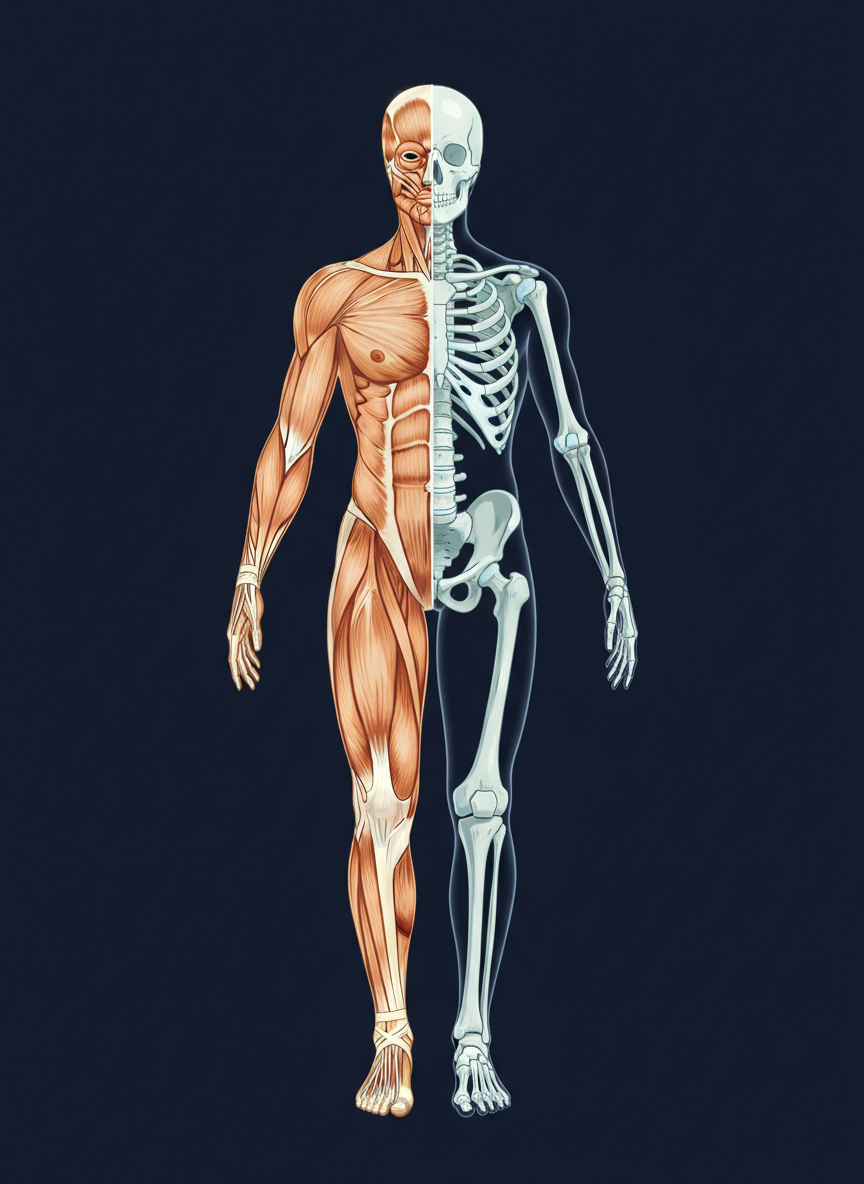
Muscles, joints, tendons, ligaments, and connective tissue don’t work in isolation. They function as one integrated system, each part depending on the others to produce and control movement. Understanding how they cooperate is the first step to understanding pain and performance.¹
Muscles generate force and, just as importantly, stabilize joints against the loads placed on them. Joints distribute that load across their surfaces, spreading force so no single structure is overwhelmed. When this coordination breaks down, stress concentrates in ways the body isn’t built to tolerate.
Connective tissue ties it all together, transferring tension between muscle and bone and storing and returning energy with each step and lift. Tendons and ligaments are living tissues that adapt to the demands you place on them over time.
Overseeing all of it is the nervous system, which modulates movement and pain moment to moment. It decides how much force to recruit, how to sequence a movement, and how to interpret the signals coming back from the tissues.²
Understanding Pain
How Pain Works
Pain is a protective signal, not a direct readout of tissue damage. Its job is to change your behavior — to make you rest, guard, or move differently. That’s a useful system in the short term, but it means pain and injury are not the same thing, and one can exist without the other.³
In persistent pain, the nervous system can become more sensitive over time — a process called central sensitization. The alarm turns up its own volume, so smaller and smaller inputs trigger a bigger response. The pain becomes real and significant even as the original tissue issue heals.⁵
Your movement patterns and load history shape all of this. How you’ve moved, trained, rested, and recovered over years teaches the nervous system what to expect and how to respond. Two people with identical scans can have completely different experiences of pain.
Pain is an output of the brain, not a measure of tissue damage.⁴
— Lorimer Moseley
This is why movement is usually medicine. Graded, well-dosed movement retrains a sensitive system, restores confidence, and rebuilds capacity. Rest has its place, but avoiding movement long-term tends to make the alarm louder, not quieter.

Daily Practice
Movement Habits & Performance
Daily movement habits compound. The way you sit, stand, lift, and train each day is a small deposit into your long-term physical account — and over months and years, those deposits add up to how resilient or vulnerable your body becomes.
Motor patterns matter for injury risk. Well-coordinated movement spreads load efficiently, while repeated compensations concentrate stress and outpace what your tissues can tolerate. Strength, mobility, and load tolerance work together to define that capacity — and small, consistent habit changes create large long-term outcomes.⁶
- Strength builds the reserve capacity that protects joints under load.⁷
- Mobility lets you access good positions instead of forcing compensations.
- Load tolerance is trained gradually — the tissue adapts to what you ask of it.
- Consistency beats intensity: small daily habits outperform occasional heroics.
Staying Ahead of Injury
Prevention: Building a Resilient Body
Resilience is built through progressive overload — gradually asking a little more of your body than it’s used to, then allowing it to recover and adapt. Tissue responds to that cycle by getting stronger and more tolerant. Skip the recovery, and adaptation stalls or reverses.⁸
Recovery is where the adaptation actually happens. Sleep, nutrition, and managed stress give tendons, muscles, and joints the time and materials to rebuild. Consistency over intensity is the guiding principle: steady, sustainable effort produces far more than occasional all-out sessions followed by long layoffs.⁹
Think of prevention as an ongoing practice, not a one-time fix. There’s no single stretch or gadget that inoculates you against injury — there’s only the habit of moving well, loading appropriately, and recovering deliberately, repeated over time.
This is where chiropractic care and therapeutic exercise fit in. Hands-on care can help restore confident movement and address specific restrictions, while a well-designed exercise program builds the strength, mobility, and load tolerance that keep those gains in place between visits.
By Body Region
Explore Ortho Health Topics
Shoulder
A mobile joint that trades stability for range, making rotator-cuff care essential.
Sports Med
Managing sports injuries and building a confident, structured return to activity.
Ready to go deeper?
Browse evidence-based articles on joint health, injury prevention, and rehabilitation strategies.
References & Sources
- Blemker SS, et al. “Structure, function, and control of the human musculoskeletal network.” PLOS Biology. 2018;16(1):e2002811.
- Standring S (Ed.). Gray’s Anatomy: The Anatomical Basis of Clinical Practice. 41st ed. Elsevier; 2016.
- Moseley GL. “A pain neuromatrix approach to patients with chronic pain.” Manual Therapy. 2003;8(3):130–140.
- Moseley GL & Butler DS. Explain Pain. 2nd ed. Noigroup Publications; 2013.
- Woolf CJ. “Central sensitization: Implications for the diagnosis and treatment of pain.” Pain. 2011;152(3 Suppl):S2–S15.
- Kiesel K, et al. “Prediction of injury by limited and asymmetrical fundamental movement patterns in American football players.” Journal of Sport Rehabilitation. 2014;23(2):88–94.
- Suchomel TJ, et al. “The importance of muscular strength in athletic performance.” Sports Medicine. 2016;46(10):1419–1449.
- Lauersen JB, et al. “Strength training as superior, dose-dependent and safe prevention of acute and overuse sports injuries.” BMJ Open Sport & Exercise Medicine. 2018;4(1):e000396.
- Dattilo M, et al. “Sleep and muscle recovery: Endocrinological and molecular basis for a new and promising hypothesis.” Medical Hypotheses. 2011;77(2):220–222.
- Gabbett TJ. “The training-injury prevention paradox: should athletes be training smarter and harder?” British Journal of Sports Medicine. 2016;50(5):273–280.
- Hayden JA, et al. “Exercise therapy for treatment of non-specific low back pain.” Cochrane Database of Systematic Reviews. 2005;(3):CD000335.
- Vlaeyen JWS & Linton SJ. “Fear-avoidance model of chronic musculoskeletal pain.” Pain. 2012;153(6):1144–1147.
 Dr. Austin Fontenot